

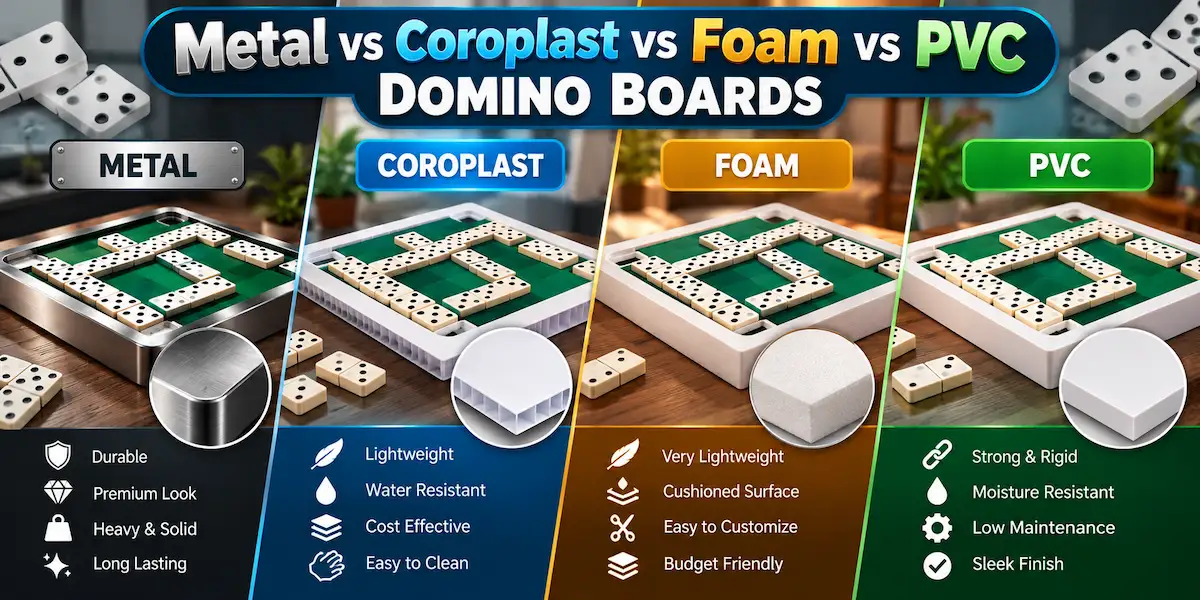
The best material for a domino board depends on what matters most to you. Do you want a board that feels solid and lasts for years? Do you need something lightweight? Will you move the board often? Does it need to handle spills or regular cleaning?
Metal, Coroplast, foam, and PVC all create very different playing experiences. Here is how each material compares before you choose your next Dominoes Solitaire board.
Metal vs Coroplast vs Foam vs PVC at a Glance
| Material | Weight | Rigidity | Moisture Resistance | Portability | Best For |
| Metal | Medium to heavy, depending on metal | Excellent | Very good with suitable finish | Moderate | Long-term home use |
| Coroplast | Very light | Moderate | Excellent | Excellent | Portable and lightweight boards |
| Foam board | Extremely light | Moderate | Limited with conventional paper-faced foam | Excellent | Light indoor use |
| Expanded PVC | Light to medium | Very good | Very good | Good | Everyday use and durable boards |
There is no material that wins every category.
The right choice depends on where your board will be used and how often you plan to play Dominoes Solitaire.
Metal Domino Board: Best for a Solid, Long-Term Setup
A metal domino board is the most substantial option in this comparison.
Metal stays rigid. It does not flex easily during normal play. This gives the board a stable feel when dominoes are being placed, moved, or picked up.
The exact experience depends on the metal used.
Aluminum is particularly useful when manufacturers want strength without excessive weight. The Aluminum Association describes aluminum as both lightweight and strong, with good corrosion resistance.
A metal board makes sense for players who keep their game in one regular location. It can work especially well on a dedicated table or in a game room.
It may also suit a large Dominoes Solitaire board, where extra rigidity helps the larger surface stay flat.
What to Consider Before Choosing Metal
Metal is not automatically the most practical choice.
A solid metal surface may create more noticeable sound when hard dominoes are placed on it. The board can also feel less forgiving than a softer surface.
Weight varies considerably. An aluminum board can remain relatively manageable, while boards made with heavier metals can be less convenient to move.
Surface finish matters too. A poorly finished board may show scratches or marks over time.
Choose metal when stability and long-term durability matter more to you than minimum weight.
Coroplast Domino Board: Best for Portability
A Coroplast domino board takes a very different approach.
Coroplast is a brand of corrugated polypropylene sheet. The material uses a twin-wall structure rather than a solid sheet. It is designed to be lightweight while still providing useful structural strength.
It also handles moisture well. Coroplast describes its polypropylene sheets as waterproof and stain resistant, and its material data reports very low water absorption.
That combination makes Coroplast useful when portability is important.
It may suit players who move their board frequently, store it after every game, or want a small Dominoes Solitaire board that is easy to handle.
It is also easier to manage when a larger board needs to stay reasonably light.
Where Coroplast Makes Sense
Coroplast is a strong choice when you want:
- Low weight
- Easy storage
- Good moisture resistance
- A board that is easy to move
- A practical surface for casual use
Foam Domino Board: Best When Low Weight Comes First
A foam domino board can be remarkably light.
However, it is important to understand what “foam board” means.
Traditional foam board usually contains a polystyrene foam core between paper facers. For example, FOME-COR consists of extruded polystyrene foam with paper surfaces. Its manufacturer highlights its very low weight and dimensional stability, but positions it mainly for short-term interior applications.
This makes conventional foam board easy to carry and store.
It can work well for a simple indoor game board that does not need to withstand heavy wear.
Foam can also provide a slightly softer feel than metal or rigid plastic.
The Main Limitation of Foam Board
Durability is where conventional foam board needs more care.
The core can dent if it receives enough pressure. Paper-faced versions are also less suitable around frequent spills or damp environments than plastic-based materials.
Some foam boards use moisture-resistant coatings or plastic facers, so not every foam product performs the same way.
PVC Domino Board: A Strong All-Round Option
A PVC domino board offers a useful middle ground.
Expanded PVC board is different from conventional paper-faced foam board.
Products such as SINTRA are made from expanded closed-cell polyvinyl chloride in a homogeneous sheet. That means the board itself is PVC rather than a foam core covered with paper.
The result is a material that can stay relatively lightweight while providing good rigidity.
Expanded PVC can also resist dents, scratches, chemicals, and moisture. Some grades are specifically described as highly resistant to moisture absorption, with no rotting or delamination.
Looking for a board that fits the way you play? Explore Dominoes Solitaire board games and compare the available board options before choosing your setup.
PVC vs Coroplast: What Is the Difference?
These two materials may look similar from a distance, but their construction is very different.
Coroplast is corrugated polypropylene. Air spaces run through its fluted structure.
Expanded PVC is a solid, closed-cell sheet.
That difference affects how each one feels.
Coroplast usually wins when minimum weight is the priority. It is especially useful when the board needs to be carried or stored frequently.
PVC feels more substantial. It generally offers greater rigidity and a smoother, more solid playing surface.
Think of the choice this way.
If you want light and practical, consider Coroplast.
If you want rigid and durable without moving all the way to metal, consider PVC.
Metal vs PVC: Which Is Better for Frequent Play?
Both can handle regular use well.
Choose metal when you want maximum rigidity and a firm tabletop feel.
Choose PVC when you still want a durable board but prefer something easier to move.
PVC also has an advantage in situations where a quieter, less metallic playing surface is preferred.
For many home players, PVC offers a practical balance between durability and weight.
For a board that will stay permanently on a game table, metal becomes more attractive.
What About a Large Dominoes Solitaire Board?
Material becomes even more important as board size increases.
A large Dominoes Solitaire board needs enough rigidity to remain flat across a wider surface.
Metal handles this very well, but added size can increase weight.
PVC is another strong option because it combines rigidity with easier handling.
Coroplast keeps a large board much lighter, although the surface may feel less solid.
Traditional foam is the easiest to lift but may not be ideal when the board will receive frequent use.
Think about whether the large board will stay in one location or be stored after every session.
That single question can narrow the choice quickly.
What About a Small Dominoes Solitaire Board?
A small Dominoes Solitaire board places less demand on the material because the overall panel is smaller.
That gives you more flexibility.
Metal can provide a compact premium feel without becoming excessively cumbersome.
PVC gives you a durable everyday option.
Coroplast works well when you want the board to remain very light.
Foam may suit casual indoor play where the board will be handled carefully.
For a small board, your decision can focus more on feel and portability than structural rigidity.
Physical Board or Dominoes Solitaire Mobile App?
Not every game needs a permanent physical setup.
A Dominoes Solitaire mobile app makes sense when portability is the main goal. There is no board to store, carry, or clean.
A physical board offers something different.
You can handle real dominoes. You can see the entire layout on a tabletop. You also get the tactile part of placing and rearranging pieces.
Many players can use both.
The mobile option works for quick play away from home. The physical board works when you want a more traditional game experience.
So, What Is the Best Material for a Domino Board?
Start with your main priority.
Choose metal if you want maximum rigidity, a solid feel, and a board that will usually stay in one place.
Choose Coroplast if low weight, portability, and moisture resistance matter most.
Choose foam if you need an extremely lightweight board for lighter indoor use.
Choose PVC if you want a balance of rigidity, durability, moisture resistance, and manageable weight.
The material should suit your routine, not simply look good in a product photo.
A board that is too heavy may stay in storage. A board that is too flexible may not give you the playing experience you want. A surface that cannot handle regular use may need replacing sooner.
Match the material to how you actually play.
Ready to build your ideal setup? Explore Dominoes Solitaire board games, choose the board style that works for your space, and start playing Dominoes Solitaire your way.
Frequently Asked Questions
Is PVC better than foam for a domino board?
PVC is generally better suited to frequent use because expanded PVC is rigid, durable, and moisture resistant. Conventional paper-faced foam board is much lighter, but it is better suited to lighter indoor use.
Is Coroplast waterproof?
Coroplast is made from corrugated polypropylene and is highly resistant to water. The manufacturer describes the material as waterproof and reports very low water absorption.
Is a metal domino board too heavy?
It depends on the metal and construction. Aluminum can provide good rigidity without the weight associated with some heavier metals. Board thickness and overall size also affect the final weight.
Which material is best for a portable domino board?
Coroplast and foam are among the lightest choices. Coroplast offers the additional advantage of strong moisture resistance, making it particularly practical for a board that will be moved frequently.
Which domino board material is best for regular home use?
Metal and expanded PVC are both strong choices for frequent home play. Metal provides a firmer and more substantial setup. PVC provides good durability and rigidity while remaining easier to handle.
